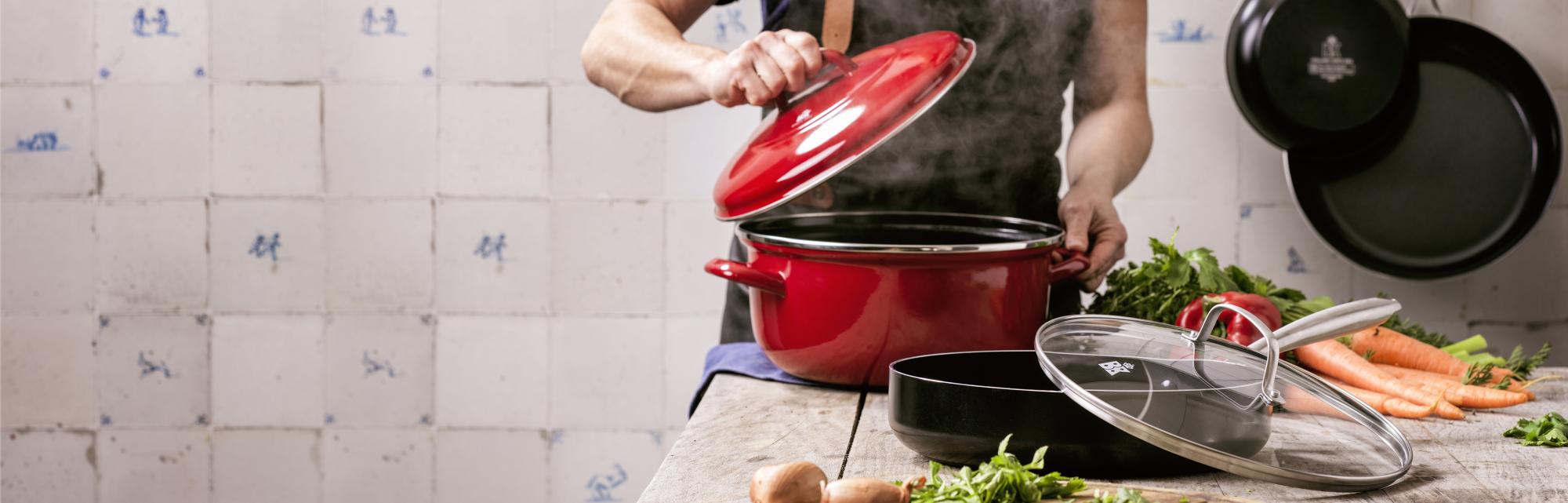

Aluminium cookware
- Stains on your hob can be caused by several things. Using a new pan on a new hob, overheating your pan, or trapping moisture between the pan and the ring it’s placed on while cooking are some potential causes.
- Stains are best removed by very briefly heating up the stained ring to a low heat, with a regular pan on top. Once the stained ring is slightly warm, use a microfibre cloth and a hob cleaner or some washing-up liquid to remove the stains.
- A melamine foam sponge (also known as a ‘magic eraser’) can also do the trick. Melamine sponges work best in combination with water, as the water activates the foam’s so-called ‘microscrubbers’. Scrub at the stains until they’re gone, repeatedly dampening the sponge. Don’t use any cleaning agents. These will only coat the surface of your hob and make the sponge less effective.
- Finally, make sure the bottom of your pan is both dry and clean before placing it on the hob. That prevents moisture from causing burn stains between the pan and the ring.
The insides of the frypans have a ceramic non-stick coating, which is sand-based and does not contain any harmful substances PFAS.
- The ring does not detect the pan or only heats up very slowly. Induction-compatible pans only work on induction rings with a diameter equal to or smaller than the base (diameter) of the pan. To improve connectivity, slightly shift the pan in relation to the centre of the ring.
- This is because the bottom of the pan consists of ferromagnetic particles, while the induction ring contains a coil. The pan’s ferromagnetic base has to be connected to the coil underneath the hob’s surface to create a magnetic field that will heat the pan.
No, accidentally consuming microscopic particles of a BK product’s non-stick coating will not harm your health.
We advise keeping the gas flame centred underneath the pan. This will prevent the handle of the pan from getting too hot, which in turn prevents it from becoming unscrewed. And of course, this is also the safest way of cooking! So always select a gas burner that matches the diameter of the bottom of your pan. The tips of the gas flame are the hottest part. Using a burner with too wide a diameter will cause your cookware’s handles to overheat. As soon as your food is warm, you can start to reduce the flames.
- Usually, this shouldn’t be a problem. Just make sure your pans are compatible with the other heat source you want to use them on. Keep in mind the following:
- Pans can warp (becoming convex or concave) when used over a gas burner. If a pan is warped, its lack of contact with the induction hob may prevent the hob from working properly. Warped pans may also wobble on the hob, which is of course less than ideal.
- Dragging a pan across the pan supports of a gas hob may damage the pan’s bottom. This could later scratch the glass surface of other hobs. Of course, if the bottom of your pan does not appear damaged, using it on another hob shouldn’t be a problem. Remember: sliding pans across a hob’s glass surface can always scratch it!
- If you’re switching to induction, make sure the bottom of your pan is ferromagnetic. You can easily test this yourself. If a magnet clings to the bottom of the pan, your pan is induction-compatible. All the pans in this collection work on induction hobs.
All the pans in this collection are dishwasher-safe. Want to keep your pans in great shape? Wash them by hand, using warm soapy water.
A few additional tips:
- Never let a hot pan come into contact with cold water, as this can cause thermal shock. As a result, the bottom of the pan may warp, becoming convex or concave. Always let your pan cool off first.
- Always use wooden or plastic spatulas without any sharp edges.
- We strongly advise against cutting food in the pan!
- When stacking your pans on top of each other, always place a protective layer in between to prevent the pans from damaging each other.
Enamel cookware
- Our coatings are applied at +800 degrees Celsius and don’t contain any toxic substances. Should a coating break down, it will start to flake or crumble into a powder. If this powder or these flakes end up in your food, you may notice a grainy texture to your food. If you consume any of this residue, it will simply exit your body the way any other food would.
- While it is unlikely your coating would break down, this may happen if a pan receives a blow or a knock, gets damaged or is accidentally dropped. In rare cases, a coating may have failed to settle properly during the spraying stage of the production process. Either way, we’re very sorry to hear you are facing any issues – we would happily look into the matter for you. We kindly ask you to send us some photos of the pan and its flaking coating via our contact form.
- Before the first use, we recommend washing new pots or pans in hot water with some mild washing-up liquid before rinsing and drying them well.
- Never scrape sharp or pointed objects across the inside of your pot, as this could result in damage that could lead to discolouration or make your food burn.
- To protect the enamel coating of your pot, refrain from tapping your spoon hard against the edge of the pot.
- Wash the pot as you would any other kitchenware, using hot water, washing-up liquid and a soft dish brush. Rinse and dry the pot well, especially along its stainless-steel edge. Alternatively, wash your pot in the dishwasher.
- When cleaning your pots, avoid using abrasive sponges (incl. steel wool), scouring powders or aggressive cleaning agents.
- To remove stains, opt for a liquid abrasive that will not damage your cookware.
- If your pan was burnt, bring a baking-soda solution to the boil in it. Take the pan off the heat and leave it to soak for a while before rinsing it.
Purchase
Unfortunately, the collection is not available online.